comparison
How far in advance should I publish the class schedule so teachers can plan their month?
Two week, four week and quarterly schedule cycles each trade flexibility against retention. Compare them on sub rate, teacher churn, marketing lead time and how much rework each one creates.
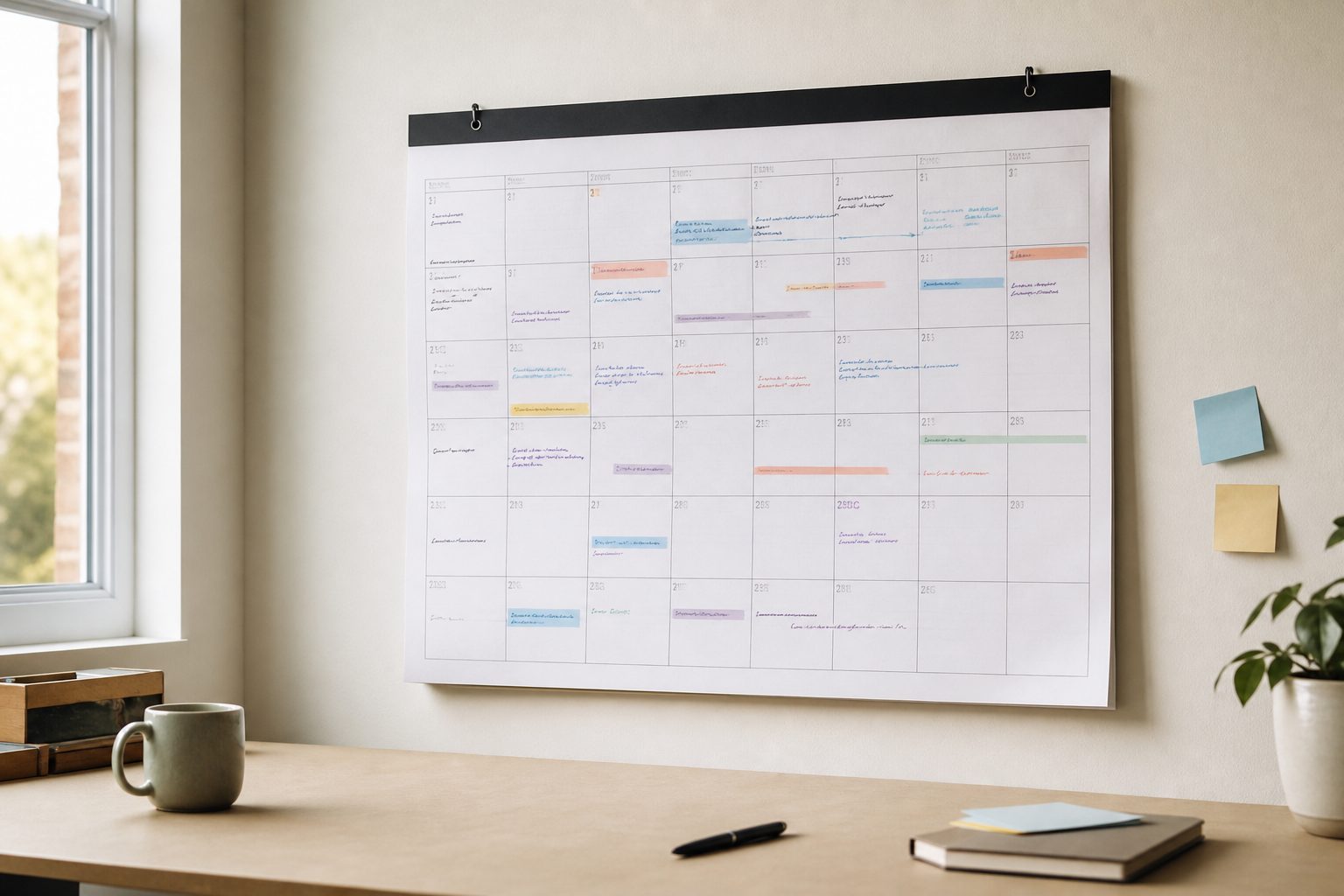
For most studios the honest answer is four weeks of published, locked classes at all times, sitting on top of a quarterly skeleton that names the time slots and the format but not always the teacher. That combination gives a teacher enough runway to book a dentist appointment, accept a retreat, or turn down a competing shift, while leaving you room to move a Wednesday 6pm from vinyasa to slow flow when attendance tells you to.
Two weeks is not enough. Teachers who work at three studios cannot hold time open for you on a two week horizon, so they commit elsewhere and you spend your evenings hunting for cover. A full quarter of locked names, on the other hand, is more precision than the world will honor. Life happens in twelve weeks, and every change you push after publication costs you a conversation.
The rest of this is the comparison itself: what each cycle asks of your roster, what it costs you in sub requests, where the law starts to have an opinion, and how to pick.
What each publishing cycle asks of your teachers
A publishing cycle is a promise about certainty. The longer the cycle, the more certainty you hand the teacher and the more you take on yourself.
| Cycle | What the teacher gets | What you carry |
|---|---|---|
| Two weeks | Very little planning room, income visible only half a month out | Maximum flexibility, maximum sub churn |
| Four weeks rolling | A full month of known income, enough to plan childcare and travel | Moderate rework, one publish event per month |
| Quarterly | Season level certainty, easy to decline outside work | Heavy rework when anything shifts, and it will |
Note the phrase "rolling" in the middle row. A rolling four week window means that on any given day, a teacher can see four weeks forward. That is different from publishing a calendar month on the 25th, which leaves the teacher with five days of visibility on the 26th. Rolling is the version teachers actually feel.
Keep reading: Why did my most reliable teacher quit two weeks after I added a Saturday morning class?
Sub requests as the real cost of a short cycle
Short cycles do not reduce your work. They move it from the schedule build to the sub request, which is the more expensive place for it to live.
Run the arithmetic on your own numbers. Say you teach forty classes a week and your sub rate on a two week cycle is eight percent, because teachers accept other work before they see your schedule. That is roughly three sub requests a week, or about thirteen a month. Say each one takes you twenty minutes of messaging, checking who is certified for that format, and confirming. Those are assumptions, not findings, so substitute your own. Thirteen requests at twenty minutes is a little over four hours a month of pure coordination.
Now assume a four week cycle drops the sub rate to five percent, because teachers can hold the slot before competing offers arrive. Two requests a week, about eight a month, a little under three hours. You bought back an hour and change, and more importantly you bought back the ten at night part.
The second cost is quality. A last minute sub is whoever answers, not whoever fits. Regulars notice when the Tuesday 9:30am restorative becomes a fast vinyasa because that was the available body.
Track your sub rate before you change anything
Count, for one month: total classes on the schedule, and classes taught by someone other than the originally assigned teacher. That ratio is your sub rate. If you do not know it, you cannot tell whether a cycle change helped.
Predictive scheduling laws and which cities they reach
Predictive scheduling laws, sometimes called fair workweek or secure scheduling laws, require covered employers to give employees advance written notice of schedules and to pay a premium when the schedule changes late. Jurisdictions that have enacted versions of these rules include Oregon statewide, plus city ordinances in San Francisco, Seattle, New York City, Philadelphia, Chicago, Los Angeles and Emeryville, California. Notice periods in these laws generally run around fourteen days.
Most of them, however, are scoped by industry and employer size. They typically cover retail, food service and hospitality chains above an employee count threshold, which means a single location yoga studio with a dozen teachers usually falls outside the covered class. Usually is not always, and the drafting differs city by city.
Two things follow. First, if you are in one of those jurisdictions, confirm coverage with an employment attorney licensed in your state rather than reasoning from a summary like this one. Second, whether or not you are covered, fourteen days of written notice is now the floor that legislatures keep landing on. Teachers in those cities work other jobs that follow it, and they will read a two week horizon as the bare minimum rather than as generosity.
Separately, whether your teachers are employees or independent contractors changes what these laws can even reach, and worker classification for yoga teachers is its own tangle governed by the federal Fair Labor Standards Act and by state tests. Do not let a scheduling decision become a classification decision by accident. If you are directing when, where and how a teacher teaches, that is a conversation to have with your accountant before you tighten your scheduling rules.
Keep reading: What does a 200 hour teacher training actually cost me to run, from start to finish?
Seasonal demand swings and the case for a quarterly spine
Studio attendance is not flat, and the swings are predictable enough to design around. January brings a surge that peaks and fades by mid February. Summer thins out weeknight evening classes and fattens weekend mornings. The week between Christmas and New Year is its own small country with its own rules. Back to school in late August or early September resets weekday morning attendance.
A quarterly spine is the answer to that. Four times a year you sit down and decide the shape of the schedule: how many slots, at what times, in what formats. Those decisions are seasonal, so they belong on a seasonal clock. Teacher assignment is a monthly decision, because that is the timescale on which human lives move.
The spine also gives you a natural moment to retire a class that is not working. Killing a class mid cycle feels like a rebuke to the teacher. Killing it at a season boundary, with the reasoning shared in advance, reads as planning.
How lead time affects workshop and series marketing
Here is where a short cycle quietly costs you revenue. A six week beginner series or a Saturday workshop needs promotion time, and promotion time is bounded by how early the date exists.
A workable sequence for a paid workshop:
- Date and teacher locked, at least eight weeks out.
- Registration page live and priced, seven weeks out.
- First email to the full list, six weeks out.
- In studio mention from teachers, starting five weeks out, every class.
- Second email plus social push, three weeks out.
- Last call email, five days out, with a seats remaining count if it is honest.
Count backward from that first step. Eight weeks of lead time is impossible if your schedule horizon is two weeks, so workshops get promoted for ten days and underfill, and then you conclude that your members do not want workshops. They may simply not have heard about it in time.
See how MatCount handles this for yoga studios
Handling teachers who hold multiple studio commitments
Assume every teacher on your roster teaches somewhere else. Most do. That means you are not competing on rate alone, you are competing on how easy you are to plan around.
Three practices that make you the studio a teacher keeps:
- Publish on a fixed date. The 15th, every month, for the following month. Predictable beats early.
- Ask for blackout dates before you build, not after. A short request window closing five days before publish costs you one message and saves four rounds of rework.
- Protect the anchor slot. If a teacher has held Monday 6pm for two years, treat that slot as theirs across cycles. Anchors are why teachers turn down other work.
Where it gets sharp is the double booking. A teacher accepts your Thursday and then a competing studio offers a better paying Thursday. If your schedule was out first and they said yes, that is a commitment. Say so once, kindly and clearly, and then hold it. Studios that let commitments dissolve teach their whole roster that commitments dissolve.
Choosing a cycle and the review point that goes with it
A short decision rule, based on where your studio actually is:
- Under fifteen classes a week, one or two teachers besides you: four week rolling window, informal season planning. The quarterly spine is overhead you do not need yet.
- Fifteen to forty classes, five to twelve teachers: four week rolling window plus a quarterly spine. This is where most studios live and where the combination pays for itself.
- Over forty classes, or more than one location: six week rolling window plus a quarterly spine, because your sub pool is deeper and your rework is more expensive.
Whatever you pick, attach a review point to it. Sixty days after the change, look at three numbers: sub rate, number of schedule edits made after publication, and whether any teacher gave notice. If sub rate did not move, the cycle was not your problem and something else is, most likely rate or the hidden hours around each class.
Making the cycle hold
A publishing cycle only works if it is visible in one place that everyone trusts. The moment the real schedule lives partly in a spreadsheet, partly in a group chat and partly in your head, the cycle stops meaning anything and you are back to messaging at ten at night.
That is the job MatCount does. Teachers enter their availability and blackout dates before you build, you publish the month in one action, and when a class does need covering the sub request goes out to everyone qualified with a one tap claim, so the first person free takes it without a thread. Pay then runs from the classes actually taught, sub included, so a covered class does not turn into a payroll correction three weeks later. Set the cycle first, then let the tool hold the line.
Read also

Why did my most reliable teacher quit two weeks after I added a Saturday morning class?
Roster churn usually traces back to changes made without the teacher present. These are the scheduling and pay decisions that quietly push out the people holding your week together.

What does a 200 hour teacher training actually cost me to run, from start to finish?
A studio teacher training looks like margin until you count lead trainer hours, manuals, Yoga Alliance registration and the studio time you pull off the public schedule. Here is the full build.

Is the unlimited monthly membership still worth it, or should I move to class packs?
Rising rent and hybrid attendance are pushing studios to rework pricing. This examines unlimited, packs, tiers and hybrid models against visit frequency, breakage and revenue predictability.